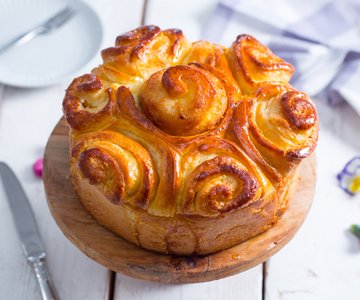
Apple Rose Cake
- 4.4
The rose is the flower of Mother's Day, and in Italy it also belongs on the table. Eleven recipes that turn the most beloved bloom of May into something you can actually eat.
In Italy, the rose has never been only a gift to hold. For centuries, it has been something you eat.
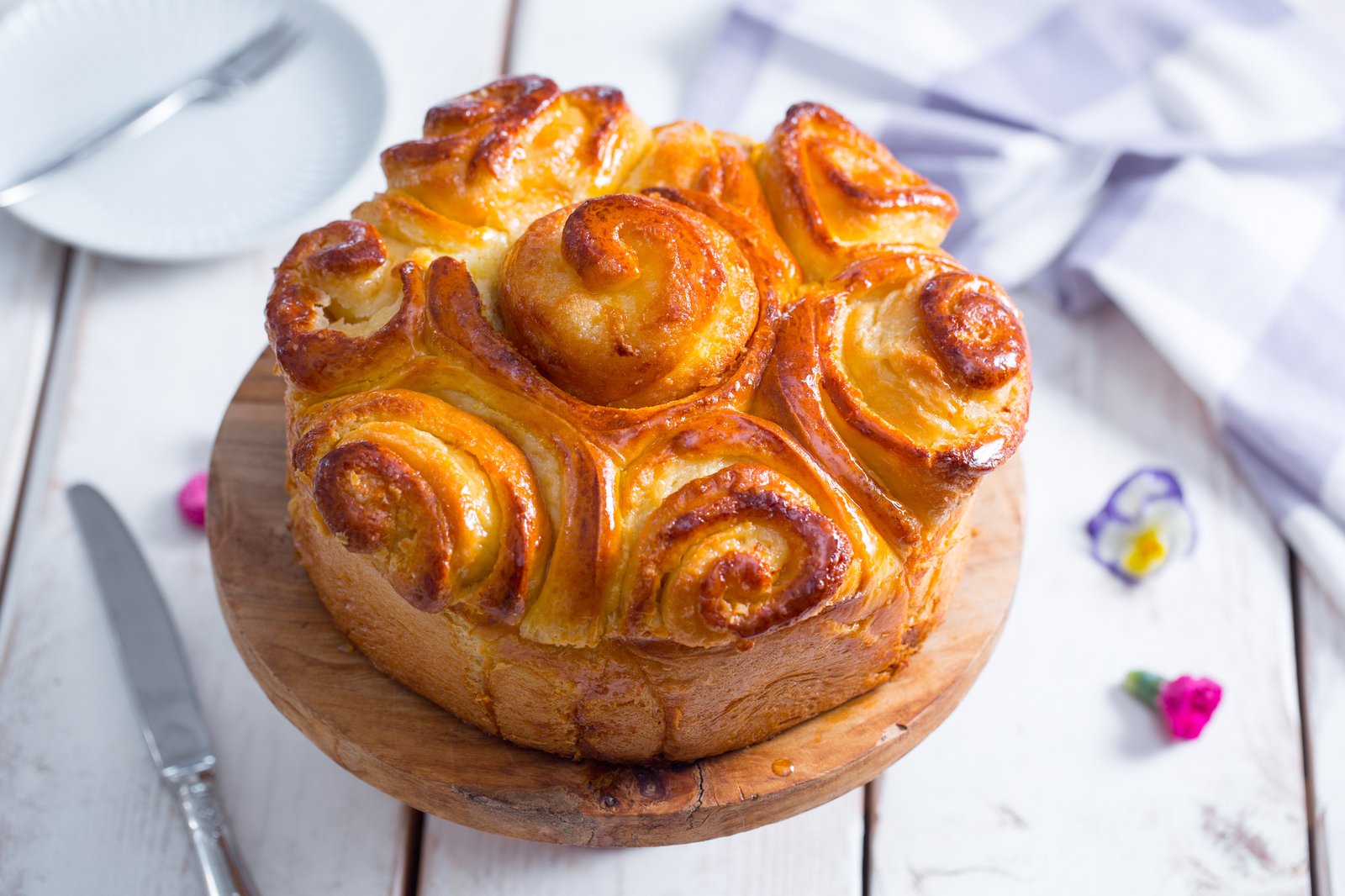
The oldest evidence of this is a cake. In 1490, a brioche was baked in the kitchens of the Gonzaga court in Mantua to celebrate the wedding between Francesco II of Gonzaga and Isabella d'Este. The dough — enriched with butter and sugar, rolled and cut into spirals — came out of the pan looking like a basket of rosebuds. It was called torta delle rose, and it stayed. More than five hundred years later, bakers in Mantua still make it the same way, and the shape is still the point.
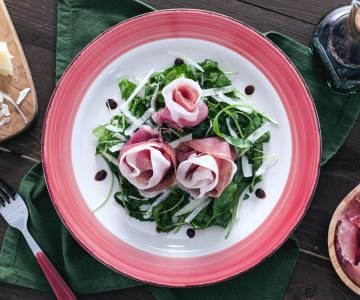
That instinct — to shape food into roses, to use the flower as both symbol and ingredient — runs through Italian cooking in ways that go well beyond dessert. It shows up in a plate of prosciutto rolled into 24 small roses over arugula and Parmigiano, in a savory bread filled with chard and cheese, in pasta dressed with fresh petals, in cookies piped into blooms and dusted with powdered sugar. The rose, in an Italian kitchen, is a gesture. It says that something matters — the occasion, the person at the table, the meal itself.
For Mother's Day, that gesture has particular weight. Below is a guide to the most beautiful rose-shaped and rose-inspired recipes in the Italian tradition, from the simplest to the most ambitious.
The Rose Cake is the anchor of this whole tradition. It is a leavened brioche dough — soft, slightly sweet, enriched with butter — rolled out into a rectangle, spread with a butter and sugar filling, then rolled up and cut into seven spirals. Those spirals go into a round pan, touching each other, and rise until they merge at the edges. When they bake, they open slightly at the top, and the result is a cake that looks, unmistakably, like a bouquet.
The technique is not difficult, but it requires patience — a first rise, a second rise after shaping, a careful hand with the dough. The reward is a cake that pulls apart in layers, each one yielding and fragrant, with a caramelized edge where the sugar filling has met the heat of the pan.
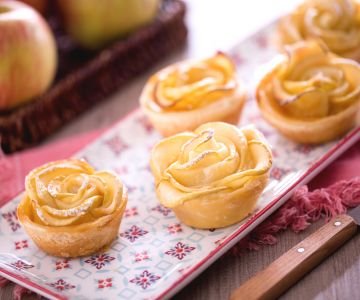
Two variations are worth knowing: the Apple Rose Cake, which tucks thin apple slices between the folds of dough with a dusting of cinnamon, and the Rose Cake with Sourdough Starter, a more complex version that uses lievito madre for a deeper, more aromatic crumb and a shelf life of several days.
The same logic that shaped the sweet torta delle rose also produces a Savory Rose Cake — same technique, same pull-apart structure, but filled with cooked ham, Edam, and red chard sautéed with garlic. It is a bread and a centerpiece at once, the kind of thing that earns its place on a table before anyone has tasted it.
More elegant, and faster to make, are the Rosa Emiliana and the Rose of Prosciutto on Puff Pastry. The first is an antipasto built on three PDO products from Emilia-Romagna — Prosciutto di Parma, Parmigiano Reggiano, and Aceto Balsamico di Modena — each slice of prosciutto rolled by hand into a small rose and arranged over dressed arugula. The second uses prosciutto crudo wrapped around goat cheese seasoned with mint and dill, set on crisp puff pastry. Both are assembled in minutes. Both look like they took considerably longer.
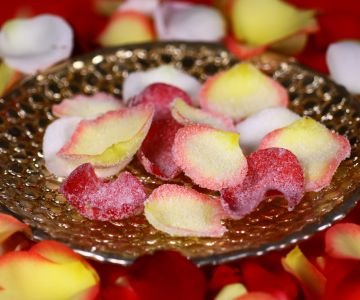
Italians have been cooking with edible rose petals since Roman times — the ancient Romans used them in preparations ranging from wine to sauces. Today the most direct expression of this is Frosted Rose Petals: petals brushed with egg white, coated in granulated sugar, and left to dry until they become translucent and crisp. They keep for days in an airtight container and will elevate anything they land on — a cake, a mousse, a bowl of ice cream.
The Cheesecake with a Scent of Roses takes the petal further, folding rose and blueberry jam directly into the filling alongside ricotta and cream cheese, then topping the set cake with a fruit gelée. The floral note is present but restrained — enough to register, not enough to overwhelm.
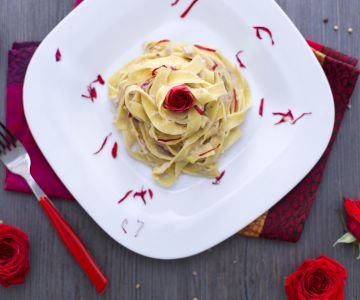
And for something that surprises at the dinner table, Tagliatelle with Rose Petals uses fresh edible petals — cut into thin strips and added at the last moment — as a garnish over egg tagliatelle with a prosciutto cotto and cream sauce. The petals contribute both color and a faint floral finish. The dish looks like spring on a plate.
Two recipes worth making in multiples. The Cocoa Shortcrust Roses are piped through a star tip directly onto the baking sheet — no cutting, no rolling — and come out of the oven as small, ridged rosettes with a crisp edge and a buttery cocoa center scented with orange zest. They keep for four to five days in a tin, which makes them an excellent gift.
The Apple Roses in Puff Pastry are individual: strips of store-bought puff pastry brushed with apricot jam, lined with thin apple slices, and rolled up into muffin cups. They bake into something that looks intricate and takes about fifteen minutes to assemble. The apple skin, left on and turned outward, forms the visible petal edge.
Not all roses are edible. For any recipe that uses petals — the tagliatelle, the frosted petals, the cheesecake — the roses must be labeled edible, meaning they have been grown without pesticides or fertilizers. Look for the word on the packaging, or grow them yourself. The base of each petal holds a slightly bitter note; for a cleaner flavor, remove it before using.
Mother's Day in Italy is, above all, a Sunday lunch. The roses on the table and the roses in the pan have always been part of the same gesture — a way of saying that the occasion deserves something made with care. Whether you start with the torta delle rose and work your way through the savory variations, or simply roll a few slices of prosciutto into small bouquets before dinner, the tradition is easy to enter. Pick one recipe, and the rest will follow.
Related: Mother's Day Brunch, Italian Style / Italian Strawberry Desserts: The Recipes Worth Making in May / No-Bake Strawberry Desserts for Spring / Six Lemon Desserts from Italy's Sunny South